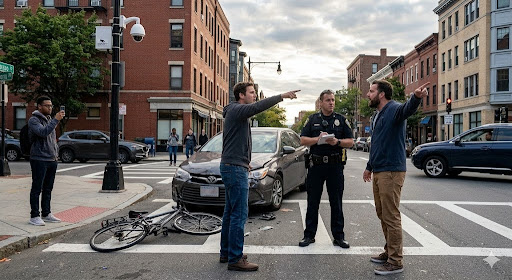
Why Both Sides Always Think They’re Right—And How Fault Actually Gets Decided
Here’s the mistake I see people make constantly, and it costs them: they assume fault in a bike-versus-car collision is obvious. That the facts speak for themselves. That whoever was “clearly” in the wrong will be identified quickly and the claim will move forward cleanly.
It almost never works that way.
I’ve spent years on both sides of these cases—first as an insurance defense investigator, now as an attorney representing injured cyclists and drivers. Two people can experience the exact same crash and walk away with genuinely different, internally consistent versions of what happened. Neither one is necessarily lying. Both might be wrong about key details. And the system that decides fault—law enforcement, insurance adjusters, and sometimes a jury—will be sorting through those competing accounts using evidence that is often incomplete, sometimes biased, and occasionally just missing.
The Myth That Fault Is Obvious
The most dangerous assumption after a crash is that the truth is self-evident.
I hear it from callers constantly: “Anyone could see what happened.” Maybe. But the legal and insurance systems don’t work on “anyone could see.” They work on documented, corroborated evidence—and in urban bike-vehicle crashes, that evidence is frequently scattered, partial, or shaped by the chaos of the moment.
There’s also a persistent myth that police reports settle the question. They don’t. A police report is an officer’s field assessment, often made in under twenty minutes, at a chaotic scene, without access to camera footage, without having spoken to every witness, and without the benefit of a reconstruction specialist. It carries weight. It is not a verdict.
One underappreciated problem: witness contamination. Crash investigation guidance from the National Highway Traffic Safety Administration specifically warns that witness confidence does not reliably equal accuracy—and that officers should collect statements quickly and separately because post-crash discussion between bystanders can corrupt individual accounts. When that doesn’t happen, the “witness version” in the report may already be a composite shaped by whoever spoke loudest or first.
How Fault Is Actually Evaluated
Liability isn’t assigned by gut feeling or by whoever files the complaint first. It’s built from a layered evidence hierarchy.
| Evidence Type | What It Establishes | Key Limitation |
|---|---|---|
| Traffic laws | Baseline standard of care for each party | Violations don’t automatically assign fault |
| Physical evidence | Speed, direction, sequence of events | Requires specialist interpretation |
| Witness statements | Fills gaps in physical record | Vulnerable to contamination and inference |
| Video footage | Objective sequence of events | Disappears within 24–72 hours if not preserved |
Traffic laws form the foundation. Every state has statutes governing cyclist and driver behavior—right-of-way rules, lane positioning, signaling requirements, speed limits, dooring zones. When a driver opens a car door into a bike lane without checking, that’s a violation. When a cyclist runs a red light, that’s also a violation. These laws establish the baseline standard of care each party was expected to meet.
Physical evidence tells the story traffic laws can’t. Skid marks, point of impact, vehicle damage patterns, bike damage, road debris—these are the forensic details reconstruction specialists use to determine speed, direction, and sequence. A car with front-end damage on the passenger side tells a different story than one with damage centered on the hood. Where a cyclist lands relative to the vehicle matters. These details can confirm or contradict both parties’ accounts entirely.
Witness statements fill the gaps—but require careful handling. An independent witness who saw the full sequence before impact is genuinely valuable. But someone who heard the crash and then looked up may have strong opinions about fault and zero direct observation of the critical moment.
Video footage has become the most reliable evidence in urban crashes. Traffic cameras, business surveillance, dashcams, cyclist helmet cameras—footage can capture what no human account fully reconstructs. If it exists, it needs to be preserved immediately. Many systems overwrite within 24 to 72 hours. This is one of the first things I tell anyone who contacts me after a collision.
Comparative vs. Contributory Negligence: A State-by-State Divide
This is where the legal framework gets consequential—and where many people are blindsided by outcomes they didn’t expect.
Your state’s negligence rules may be the single most important factor in determining what your case is actually worth.
Pure Comparative Negligence Fault is shared proportionally. If you’re a cyclist found 20% at fault and the driver is 80% at fault, you recover 80% of your damages. Your partial fault reduces recovery but doesn’t eliminate it.
Modified Comparative Negligence Same proportional logic, but with a cutoff. Depending on the jurisdiction, if you’re found 50% or 51% or more at fault, you’re barred from recovering anything. The threshold varies by state.
Contributory Negligence The harshest standard, still applied in a small number of states. If you contributed to the crash in any way—even 1%—you may be barred from recovering anything at all. A cyclist who made a minor technical error while a driver was doing something far more dangerous can walk away with nothing.
Insurance adjusters know these rules intimately, and they use them. When an adjuster calls quickly after a crash and sounds sympathetic and reasonable, understand that they are simultaneously building a picture of your potential comparative fault. Every statement you make can shift the percentage. This is not paranoia—it’s how the system operates.
The 72-Hour Window
The evidence that determines your case either gets preserved or disappears in the first three days. Here’s how that timeline typically unfolds.
At the scene: Law enforcement arrives and begins their assessment. In an ideal world, officers take statements from all parties separately, photograph the scene thoroughly, note road conditions and visibility, and document positions before anything is moved. In reality, busy urban intersections get cleared quickly, statements get taken in proximity to each other, and the officer’s initial impression—formed in the first few minutes—often shapes the entire report.
If you’re physically able, document everything yourself. Photograph your bike, the vehicle, the road, traffic signals, signage, skid marks, and your injuries. Get names and contact information from every witness before they leave. Note the time, weather, and lighting. These details seem obvious in the moment and are routinely lost.
Within 24 hours: Begin identifying camera footage. Contact nearby businesses. Note traffic cameras at the intersection. If you have a helmet camera or the driver had a dashcam, that footage needs to be preserved—formally, with written notice if necessary.
Within a few days: The police report becomes available. Read it carefully. If it contains factual errors—wrong location of impact, missing witness information, an incorrect account of the sequence—those errors can be challenged. A police report is a document, not a decree. Supplemental statements, additional witness accounts, and expert reconstruction can all build a more complete picture.
When the Initial Record Is Wrong
So the report got something wrong. A witness wasn’t interviewed. The camera footage wasn’t pulled. What now?
Don’t assume the record is fixed. I’ve worked cases where the initial police report pointed clearly in one direction and the final liability determination went the other way entirely, because additional evidence came to light during the investigation process. The investigation doesn’t end when the report is filed—it ends when the claim is resolved or the case goes to trial.
Gather your own witness statements as soon as possible. If someone saw what happened and didn’t speak to police, their account can still be documented and submitted. Written statements, video statements recorded on a phone, detailed emails describing what they saw—all of this can become part of the evidentiary record.
Document your own account carefully and early. Write down everything you remember about the crash as soon as you’re able—before memory fades, before you’ve heard other versions, before anyone has told you what you “should” have done differently. Memory is reconstructive. The earlier you capture your account, the more reliable it will be.
If the collision involved serious injury, property damage, or a fault dispute that insurance is not resolving fairly, consulting with an attorney early matters. A boston bicycle accident lawyer familiar with local traffic patterns, intersection histories, and the specific negligence standards in your jurisdiction can identify evidence you might not know to look for—and challenge a record that doesn’t reflect what actually happened.
“But Insurance Already Decided”
An insurance company’s initial determination is not final. Full stop.
Adjusters make preliminary assessments based on whatever information they have at the moment—which is often just the police report and one party’s account. Those assessments change when new evidence is presented. If you believe the initial determination misrepresents what happened, you have the right to dispute it: submit additional evidence, request a formal review, and in many cases escalate to your state’s insurance regulatory authority if the process feels fundamentally unfair.
The system has friction built into it. It also has appeal mechanisms that exist precisely because initial assessments are imperfect.
Quick Reference: What to Do and When
- At the scene — Photograph everything, collect witness contacts, note conditions
- Within 24 hours — Identify and request preservation of all camera footage
- Within 48 hours — Write your own detailed account while memory is fresh
- Within a few days — Obtain and review the police report for errors
- Ongoing — Document all medical treatment and correspondence with insurers
- Before speaking to adjusters — Understand your state’s negligence standard
Where to Go From Here
If you’re reading this after a collision—or trying to help someone who is—the most important thing you can do right now is preserve evidence and document your account before more time passes. Contact the businesses near the scene about camera footage today, not next week.
For understanding your state’s specific negligence rules, the Insurance Information Institute and your state’s department of transportation both maintain accessible resources. For anything involving injury, disputed fault, or an insurance process that feels stacked against you, a consultation with an attorney who handles bike-vehicle collisions in your city is the clearest path to understanding what your actual options are.
The truth doesn’t always surface on its own. But with the right evidence and the right understanding of how fault is determined, it has a much better chance.